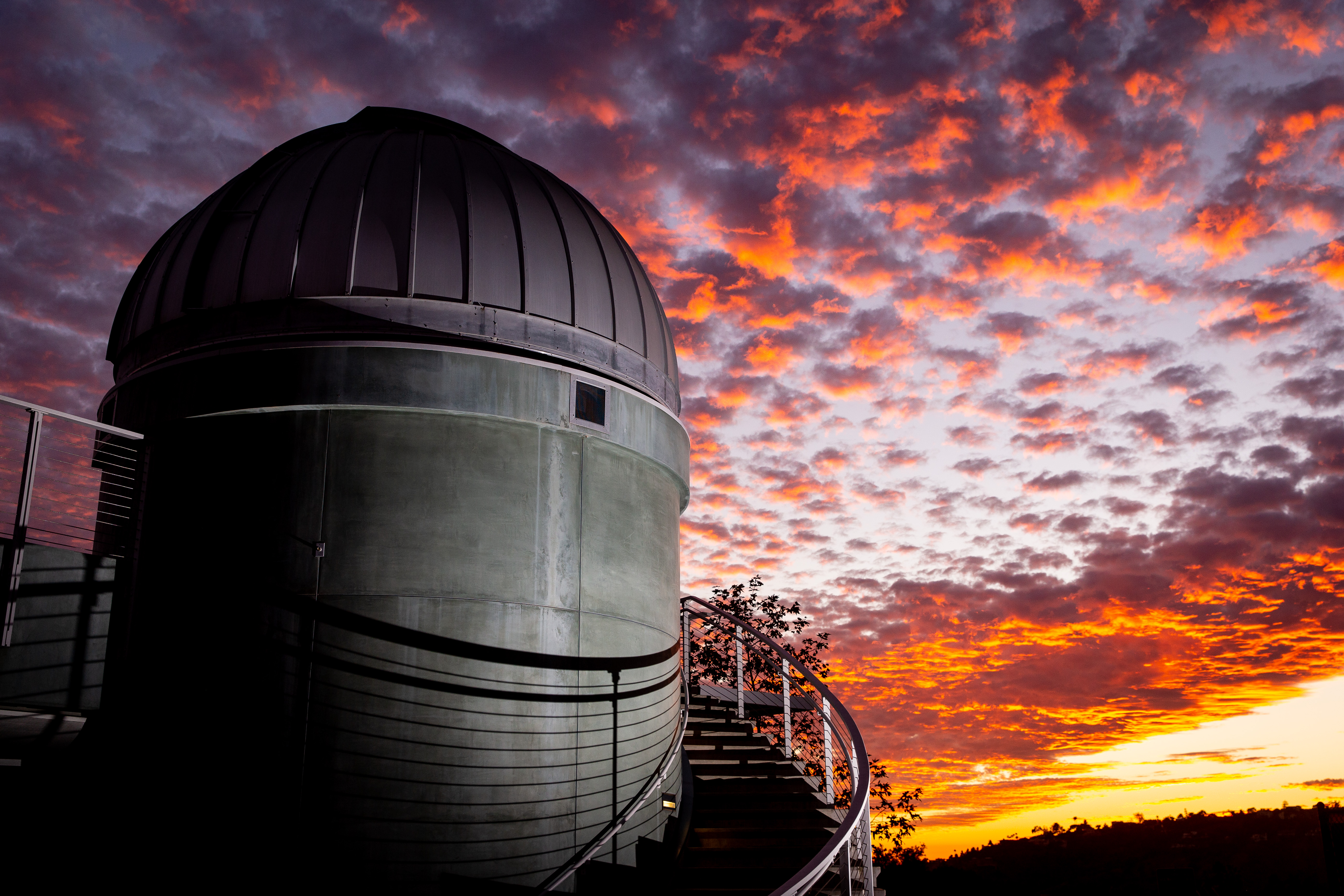
Pair an Astrophysics Minor with Your Existing Major
An Astrophysics minor provides a foundational exploration of the physical laws governing our universe, integrating hands-on astronomy with analytical depth. Students gain practical experience, from operating an advanced optical telescope and planning observation schedules to analyzing scientific data, while honing problemsolving, critical thinking, and programming skills. The 24-unit program includes core physics courses and an Observational Astronomy requirement, with electives such as Astrophysics I or II, Mathematical Physics, Classical Mechanics, Quantum Mechanics, Electricity and Magnetism, or Thermodynamics. Graduates are well equipped for diverse careers as data analysts, science communicators, researchers, planetarium directors, or educators. Students may also engage in faculty-led research in areas like cosmology and variable-star astronomy. Speak with our physics faculty to learn how the Astrophysics minor can deepen your scientific understanding and broaden your academic path.
Career Opportunities
Data Analyst Science Journalist Researcher Planetarium Director Science Instructor | Astrophysicist Observatory Technician Aerospace Analyst Space Policy Advisor Science Educator |
See career paths for graduates who minored in Astrophysics at Westmont.
Faculty and Staff



Research Opportunities
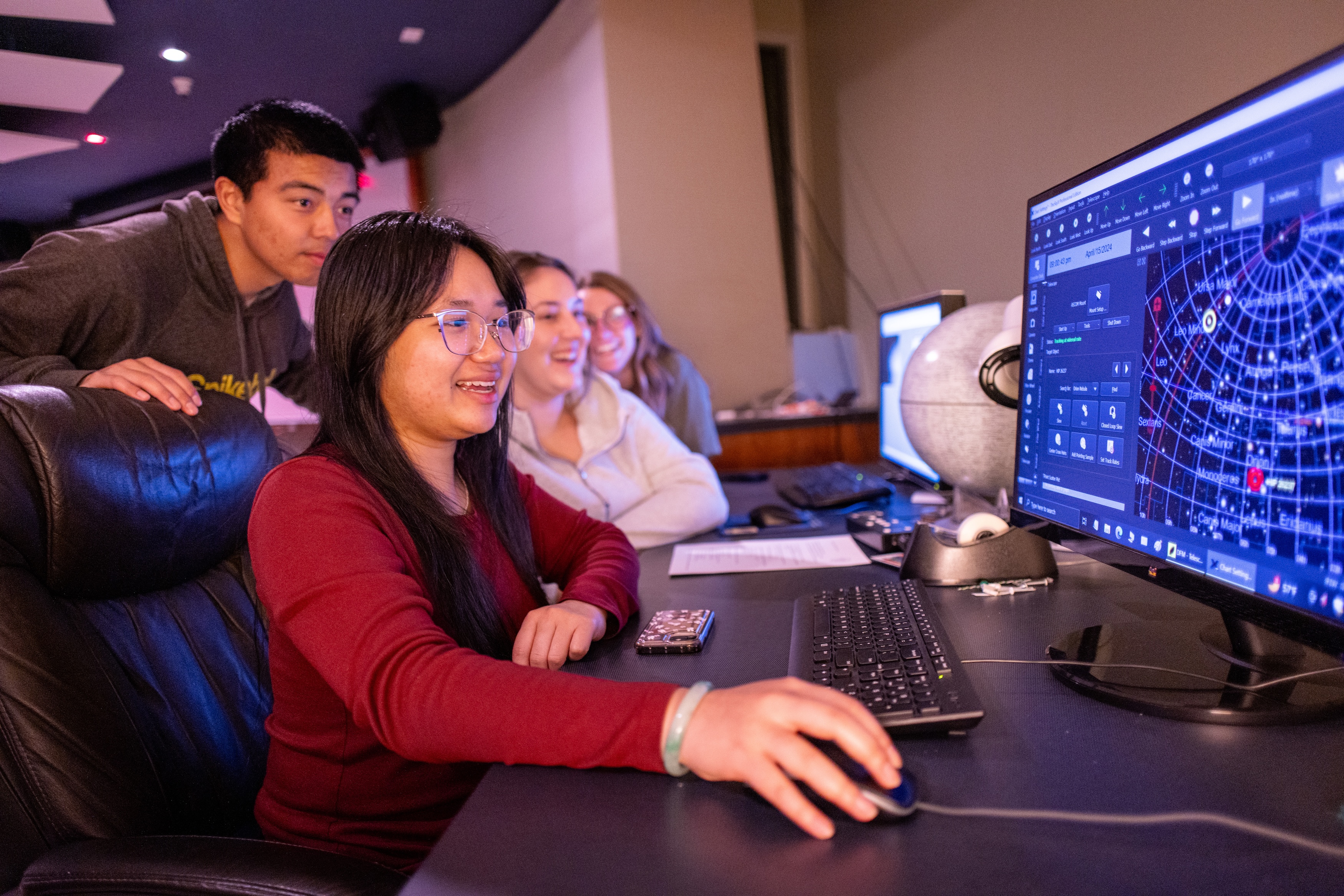
- Variable Star Astronomy
- Astronomy Education Research
- Stellar Astrophysics
Requirements for a Minor: 24 units
- PHY 021, 023 General Physics I, II (4, 4)
- PHY 022, 024 General Physics Laboratory I, II (1, 1)
- PHY 025 Modern Physics (4)
- PHY 026 Modern Physics Laboratory (1)
- PHY 125 Observational Astronomy (1)
- One of the following:
- PHY 127 Astrophysics I (4)
- PHY 128 Astrophysics II (4)
- One of the following:
- PHY 115 Mathematical Physics (4)
- PHY 121 Quantum Mechanics I (4)
- PHY 131 Classical Mechanics (4)
- PHY 150 Electricity and Magnetism (4)
- PHY 160 Thermodynamics (4)*
*EN 120 Thermodynamics may not be substituted
- PHY 125 Observational Astronomy (1) Prerequisites: CS 010 and PHY 025 (PHY 105 is recommended). This course is an advanced laboratory course (junior/senior level) that explores observational and analytical techniques in optical astronomy. Experiments include topics of astrometry, instrumentation, and optical imaging. Computational analysis is integral to the course as well as other experimental methods and techniques.
- PHY 127 Astrophysics I (4) Prerequisites: PHY 021 and PHY 023. Topics include introductory astronomy, stellar physics, star formation and evolution, and galaxy formation and evolution.
- PHY 128 Astrophysics II (4) Prerequisites: PHY 021 and PHY 023. Topics include extrasolar planets, interstellar medium, special and general relativity, and cosmology. PHY 127 and PHY 128 may be taken in any order