
Alumni Stories
Zion Shih ’21 attends Loma Linda University, where she studies Translational Medicine as an MD-PhD student, and plans to bring her work with patients into the lab to innovate and improve patient outcomes.
Margot Kulberg ’22 has been accepted to a research graduate program at the University of Iceland, studying orca whales.
Seun Alofayan ’23 is a research associate at Belharra Therapeutics, where he works on novel biotherapies that focus on drug development, medical diagnostics, and patient care.
Michael Kong ’23 works as a substance-abuse counselor in Seattle, WA, providing mental health assistance and making treatment recommendations in a criminal justice setting.
Research and Internships
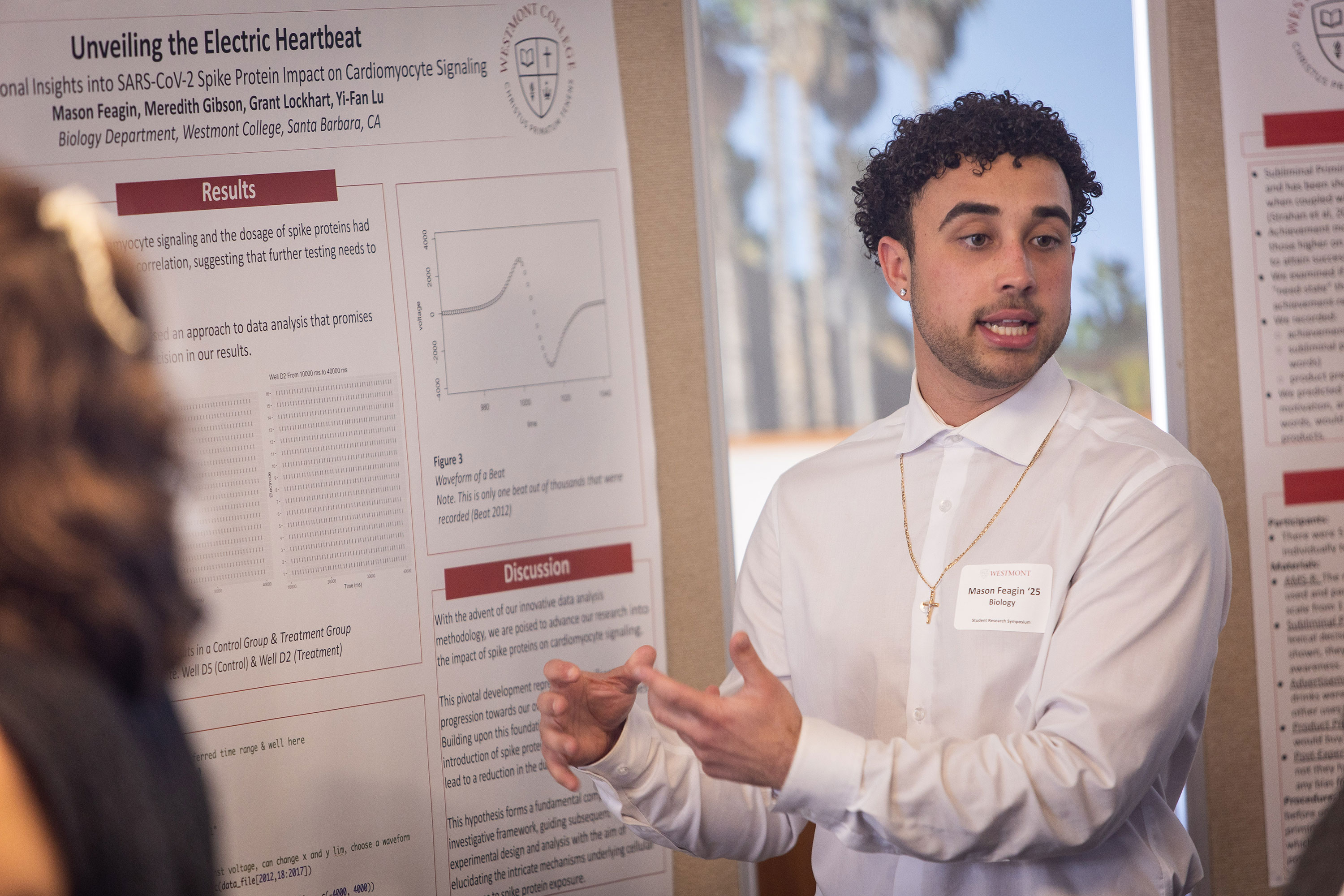
Explore many opportunities in biology research and internships
Our program provides students with the opportunity for medical and biotech internships (BIO 190, 190SS), as well as environmental internships with organizations such as the Santa Barbara Museum of Natural History, the Santa Barbara Botanic Garden, and the Santa Barbara Zoo (BIO 191, 191SS).
Career Opportunities
Teaching (elementary, secondary and college)
Health sciences (M.D., P.A., nurse practitioner, D.O., dentist, chiropractor)
Public health (epidemiology, policy, education, research)
Forensics
National Park Service (park ranger, fish and wildlife biologist)
Ecology and conservation biology
Biotechnology
See Career Paths for Graduates Who Studied Biology at Westmont
Faculty and Staff




Administrative Assistant
Email: biologyadmin@westmont.edu
Tel: (805) 565-6151
Office: WS 126

Opportunities Off Campus
- Westmont’s Global Health Uganda
- Organization for Tropical Studies: Tropical Diseases, Environmental Change and Human Health, Costa Rica
- Creation Care Studies Program, Belize, Michigan, New Zealand or Washington
Au Sable Institute of Environmental Studies
Biology Tracks & Requirements
The biology department offers three options leading to a bachelor of science degree in biology—a general track providing a comprehensive introduction to all areas of biology, a more specialized track emphasizing cellular and molecular biology and a track emphasizing environmental biology and natural history. Each track is comprised of lower-division courses in biology, mathematics, and physical sciences, plus a variety of required and elective upper-division courses.
Cellular and Molecular Biology Track
The bachelor of arts major in biology consists of lower- and upper-division course work in biology and supporting physical sciences and mathematics. The program is designed for students who wish to obtain a strong preparation in biology, while also obtaining a broader exposure to courses outside the major than is generally possible with a bachelor of science degree.
- BIO 5, 6 General Biology I, II (4,4)
- Upper-division BIO Electives (12)
Biology majors may also be interested in completing an interdisciplinary Environmental Studies minor.
Up to two upper-division qualifying Biology courses can be applied to the minor.
Click on the link below to check out the ENV minor website, and contact Dr. Amanda Sparkman for more details.
Wherever your pre-health plans may ultimately lead you, they all share one key element: a strong foundation in biology. And Westmont's Biology major is designed with this in mind.
Our classes will deepen your understanding of the wondrous complexities of the body. And our research experiences - including opportunities for discovery in neuroscience, hormonal regulation, and infectious disease - will train your mind to think scientifically and critically in a field that demands those skills. More importantly, these experiences are woven together with a consideration of the ethical and theological concerns that shape the practice of the health sciences - those "big picture" questions that are central to the work of any health practitioner. We invite you to a major that will not only prepare you for admission to a graduate program, but also provide you with tools of critical and Christian thinking that are vital to a career of service in the health industry.
Click on this link to see our pre-professional programs: pre-dentistry, pre-medicine, pre-vet, pre-nursing, pre-pharmacy, pre-PA.
Biology majors may also want to consider pursuing a K-12 teaching credential at Westmont.
To learn more, please visit the Education department's website on the Teaching Credential program in general, as well as the Fast Track page for Biology majors in particular.